Featured Research
-

Design and commissioning of DAPPER at Texas A&M
The Detector Array for Photons, Protons, and Exotic Residues (DAPPER) was commissioned at Texas A&M University’s Cyclotron Institute. Neutron transfer in (d, p) reactions in inverse kinematics with rare isotope beams offers a means to access key aspects of the capture process. Its first experiment used a 57Fe beam to study 58Fe, demonstrating DAPPER’s potential to improve neutron-capture predictions for stable and radioactive nuclei.
View publication on “Development of the detector array for photons, protons, and exotic residues"
-

Production and purification of 240Am at the University of Washington
An optimized method was developed to produce and purify 240Am through deuteron-induced activation of a 240Pu target at the University of Washington's CENPA facility. The approach was evaluated for its ability to provide material with the yield and purity needed to measure the 240Am(n,f) cross section.
-

A Centralized Resource for Experimental Nuclear Level Densities
The nuclear level density is a key ingredient in modeling nuclear reactions through Hauser-Feshbach calculations, but experimental data have long been dispersed throughout the literature. Researchers at Ohio University have led the development of the Current Archive of Nuclear Density of Levels (CANDL), an open-access database that brings together experimental level density measurements from multiple techniques into a single, searchable platform. By making these data easier to access, compare, and analyze, CANDL provides a valuable resource for improving nuclear reaction models.
View Publication on "A new database website for nuclear level densities"
-

Comprehensive, statistically rigorous update on thermonuclear reaction rate evaluation
This work presents a comprehensive analysis of thermonuclear reaction rates, emphasizing modern statistical approaches such as Monte Carlo sampling and Bayesian models. Experimental nuclear data have been evaluated to estimate 78 charged-particle reaction rates in the A = 2–40 mass region, over temperatures ranging from 1 MK to 10 GK. Recommended low, median, and high reaction rates are provided, along with factor uncertainties at each temperature grid point. A graphical comparison of the new results with previously evaluated Monte Carlo rates is also provided. These experimentally derived rates serve as a valuable resource for nuclear astrophysics applications.
View Publication on: “The 2025 Evaluation of Experimental Thermonuclear Reaction Rates (ETR25)”
-

Neutron capture measurement station at UMass Lowell Research Reactor
A new facility was designed around the thermal column beam port of the 1 MW Research Reactor at the University of Massachusetts Lowell. Thermal neutrons are collimated to a 1-inch diameter beam and incident on samples to induce the radiative neutron capture. The new measurements of capture gamma-rays are underway to improve the data on several samples including Mn, Gd, Cu, Ni and Cr. These measurements will use state-of-the-art coincidence spectroscopy to reduce the unwanted backgrounds which plagued older measurements. The new experimental results on the capture gamma-ray intensities will be incorporated in future ENSDF evaluations.
View Publication on "Neutron capture measurements at UMass lowell research reactor"
-

LSTAR designed and simulated for TAMUTRAP at Texas A&M
A new isobar separator, LSTAR (Light-ion guide Separator for Texas A&M’s Radioactive ion beams) has been designed as a crucial component of TAMUTRAP, which is currently under construction at Texas A&M University. LSTAR serves as a mass separator aimed at purifying the radioactive beams produced using the light-ion guide (LIG) technique with a 3He primary beam. Once commissioned and operating, LSTAR will be used to transport purified exotic beams to the existing TAMUTRAP facility. The main purpose of TAMUTRAP is to probe for physics beyond the standard model by searching for possible scalar or tensor currents in the weak interaction using nuclear 𝛽 decay.
-
A detailed view at nuclear magnetism
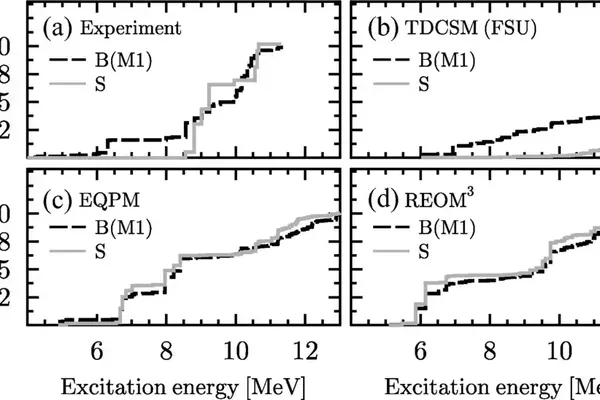
Magnetic dipole, M1, strengths were studied in semi-magic 50Ti up to the neutron-separation threshold by combining data from (d,p) one-neutron transfer, (γ,γ') real-photon scattering, (e,e') inelastic scattering at extreme backward angles, and (p,p') at Ep = 210 MeV and extreme forward angles. The combination of all probes provided the international team around FSU graduate student Bryan Kelly, FSU Associate Professor Mark Spieker, and FSU Professor Alexander Volya with unique access to the neutron spin-flip contribution and the possibility to evaluate its role in generating the spin-flip M1 strengths in the N=28 isotone 50Ti. The small contribution of the neutron (1f7/2)−1(1f5/2)+1 spin-flip transitions, which were probed with the (d,p) reaction, to the overall strength in 50Ti questions the standard picture for the microscopic origin of spin-flip strength in the fp shell. For 50Ti, the team showed that 1+ states with larger neutron (1f7/2)−1(1f5/2)+1 spectroscopic factors do not correspond to the ones with the largest B(M1;0+ → 1+) strengths. The results were published in Physical Review Letters which features researchers from three ARUNA institutions: FSU, TUNL and WMU.
View Publication on "Detailed View at Magnetic Dipole Strengths: The Case of Semimagic 50Ti"
-

Enge Spectrometer Used in First Experiment at Notre Dame
The Notre Dame Enge Split-Pole Spectrometer was transferred from ORNL and underwent a complete refurbishment. Its availability opens new opportunities to study nuclei with high precision using transfer reactions.
View Publication on "The Enge Split-Pole Spectrograph at the University of Notre Dame"
-

CeBrA demonstrator commissioned at FSU SE-SPS
A highly selective experimental setup for particle-γ coincidence experiments at the Super-Enge Split-Pole Spectrograph (SE-SPS) of the John D. Fox Superconducting Linear Accelerator Laboratory at Florida State University (FSU) using fast CeBr3 scintillators for γ-ray detection has been commissioned. A new publication reports on the results of characterization tests for the first five CeBr3 scintillation detectors of the CeBr3 Array (CeBrA) with respect to energy resolution and timing characteristics. Results from the first particle-γ coincidence experiments successfully performed with the CeBrA demonstrator and the FSU SE-SPS are also presented. The new setup enables very selective measurements of γ-decay branching ratios and particle-γ angular correlations using narrow excitation energy gates, which are possible thanks to the excellent particle energy resolution of the SE-SPS.